
Professional CV Writers in London: A Guide
Published Nov 14, 2026
Professional CV writers in London charge £65 to £799+. Real prices by career stage, how to choose a writer, the red flags, and the free DIY route.

How much does a professional CV writer in London cost?
A professional CV writer in London charges £65–£149 for a graduate CV, £125–£249 for a mid-career CV, and £395–£799 for an executive CV. Hire one if you are changing sector, returning after a long break, or applying for senior roles. For most other job seekers, a UK template and an ATS check do the same job for free.
That short answer hides the real question. The price is not the hard part. The hard part is knowing whether paying changes your outcome at all — and, if it does, which writer is worth the money and which one is selling you a nicely formatted version of the same weak CV. London has both kinds, sometimes at the same price.
PakkiNaukri is a free job board and CV builder for job seekers in Pakistan and for visa-sponsorship jobs in the UK, USA, Europe, the Gulf, Australia and New Zealand. The board holds 8,813 checked jobs live, with 204 new jobs added today, counted on 14 November 2026. This guide is written from the other side of the desk: we see the CVs London recruiters actually shortlist, and the ones they bin in six seconds. Everything below is practical — what writers do, what they charge, how to judge one, and how to get the same result yourself if you would rather keep the money. No writer is named here, because a guide that sells you one company is an advert, not advice. Prices are given as market bands from published London provider prices checked on 14 November 2026, so you can compare any quote you receive against them.
If you only want the shape of a good London CV before you decide anything, our UK CV format guide shows the exact section order, length and personal-details rules that London recruiters expect.
What does a professional CV writer in London actually do?
A professional CV writer is someone you pay to rebuild your CV from scratch, or to rewrite the one you have, so that it reads the way a London recruiter reads. That is the whole job. It is not design work, and it is not magic. A good writer does four things, in this order, and if any of them is missing you are overpaying.
First, they ask what you are aiming at. Not "what jobs do you want" in general, but which roles, at which level, in which part of London. A CV for a finance analyst in the City is a different document from a CV for a staff nurse applying to an NHS trust, and a writer who treats them the same is not doing the job. The targeting conversation — usually a call or a long questionnaire — is where the value lives. If a writer starts writing before they know your target roles, they are filling a template.
Second, they dig out your evidence. Most people write duties: "responsible for managing the team." A writer's real skill is turning that into proof: how big the team was, what changed while you ran it, what the result was worth. They will push you for numbers you forgot you had — the budget you controlled, the waiting list you cut, the error rate you halved. This is the part people find hardest to do alone, because it feels like boasting. It is not boasting. It is the only thing a recruiter can compare.
Third, they rebuild the structure. London recruiters scan, they do not read. The writer puts the strongest evidence where the eye lands first, cuts the rest, and makes the whole thing fit two pages. They also write it so an applicant tracking system can parse it — standard headings, no tables or graphics holding text, keywords that match the adverts you are targeting. Our guide on how to write a CV that gets replies walks through the same structure if you want to see what "good" looks like before you pay anyone.
Fourth, they hand you a file you can actually use: an editable Word document and a PDF, not a locked PDF you cannot update when your next role comes along. If a writer only sends a PDF, that is a warning sign, and it is covered in the red-flags section below.
What a writer does not do is get you the job. No honest writer promises interviews, and the honest ones say so on their own pages. A CV opens the door to a conversation. The interview, the references, the right-to-work check — those are still yours. Keep that in mind when you see a price. You are buying a better shortlisting chance, not a job.
How much do professional CV writers in London cost?
London prices sit in clear bands, and knowing them is the fastest way to spot a bad quote. A graduate CV from a real writer starts around £65 and rarely needs to pass £149. A mid-career CV — three to ten years of experience — usually lands between £125 and £249. Senior managers pay £249 to £399. Executive and C-suite CVs run £395 to £799 and beyond, because they involve a strategy call, board-level positioning, and often a LinkedIn rewrite and a cover letter in the same package. A straight rewrite of a CV you already have usually costs £120 to £300.
Those are the bands for the CV alone. The extras are where quotes diverge. A cover letter typically adds £50 to £150. A LinkedIn profile rewrite adds £79 to £149. Interview coaching is usually sold by the hour. Rush delivery — 24 to 48 hours — commonly adds 25 to 50 percent. And check whether the price includes VAT: providers with turnover above £90,000 must charge 20 percent VAT, and a quote that looks cheap can grow by a fifth at the invoice.
The table below puts the bands together with what is normally included at each level, so you can hold any quote against it.
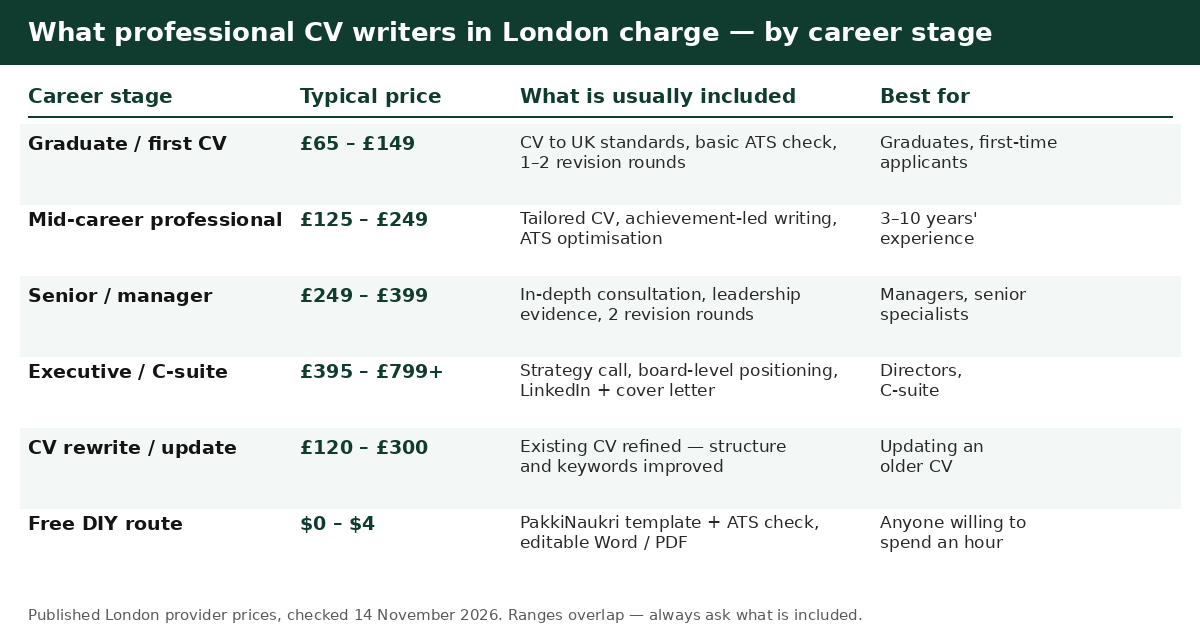
Typical London CV-writing prices by career stage, from published provider prices checked 14 November 2026.
Two things about that table are worth saying plainly. First, the ranges overlap because writers bundle different extras — a £195 CV that includes two revision rounds and a LinkedIn rewrite can be better value than a £145 CV that includes one draft and no revisions. Always ask what is included, in writing, before you pay. Second, the cheapest option on the page is not a writer at all. The free DIY route — a UK template plus an ATS check — costs nothing on PakkiNaukri's free tier and $4 at most on Premium, and for most roles under £40,000 it produces a CV that passes the same gates. The price table is there so you can judge writers honestly, not so you feel forced to hire one.
There is one more cost that never appears on a quote: your time. A proper writer-led CV takes two to three weeks from the first call to a finished document — a draft in three to seven working days, then a revision round or two. If you have a deadline this week, say so before you pay, and get the rush fee in writing. A writer who promises a bespoke executive CV in 24 hours is either not bespoke or not honest.
If you want the wider picture on formats before you compare prices, CV formats explained shows how the one-page, two-page and skills-based layouts differ, and which one London recruiters actually prefer.
Should you hire a CV writer, or write your own CV?
This is the question the whole article exists to answer, and the honest answer is: it depends on your situation, not on your budget. Run the two-minute test below before you spend anything. It sorts most people correctly, and it is the same test a good writer would run on you in a free consultation — except here nobody is trying to sell you the next step.
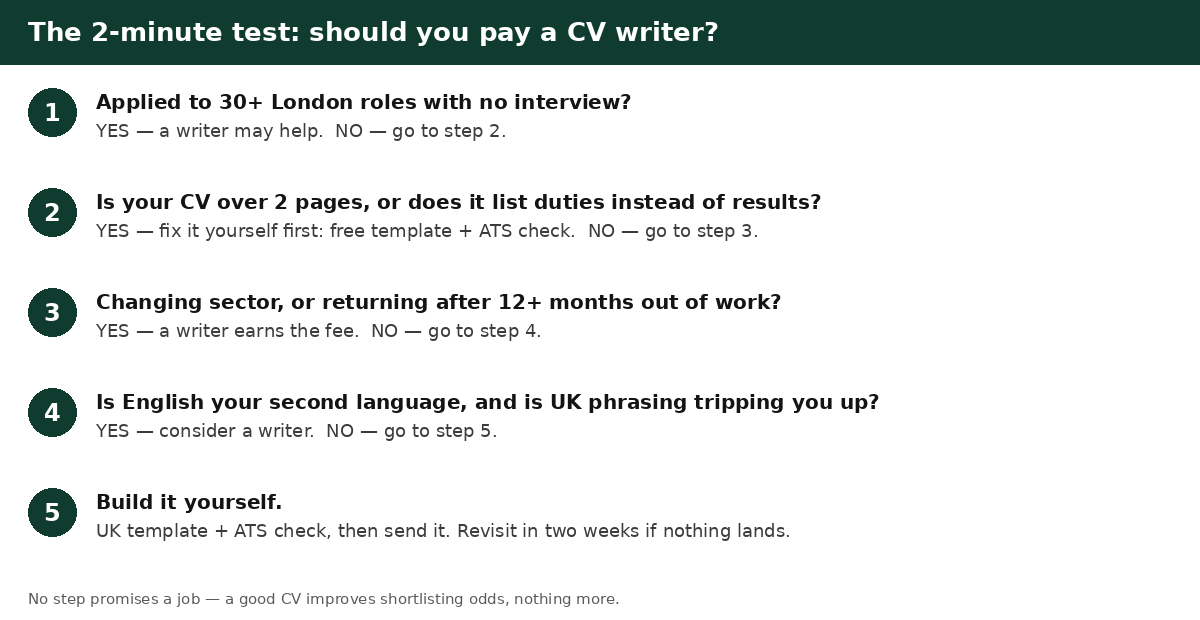
The 2-minute test: should you pay a CV writer?
Three situations where paying is usually worth it. First, a career change. If you are moving from the NHS into medical sales, or from the military into the Civil Service, your old CV describes a world your new employer does not live in. Translating clinical work into commercial language — "managed a patient caseload" becomes "managed a portfolio of 40-plus stakeholders" — is genuinely hard to do alone, and it is the exact skill a specialist writer sells. Budget £150 to £249 for this, and pick a writer who has done your target sector before.
Second, a long gap. Twelve months or more out of work, a career break for family, a redundancy that still stings — these need careful handling on paper, and the difference between an honest framing and an evasive one is the difference between an interview and a bin. A writer earns their fee here by making the gap boring and the recent evidence loud.
Third, senior roles. If you are applying for jobs paying £60,000 or more, a £400 CV is a small fraction of one month's salary, and the competition at that level is other people who also had their CVs professionally written. At that level you are not buying writing, you are buying positioning: which three achievements lead, what gets cut, how your leadership reads on one page.
Three situations where paying is usually a waste. First, your CV has never been tested. If you have sent five applications and heard nothing, you do not yet know whether the CV is the problem. It could be the roles, the timing, or the cover letter. Fix the obvious things first — two pages, achievements not duties, keywords from the advert — and run it through an ATS check. You can check your CV's ATS score free, and that single step catches the most common reason London applications vanish: the system could not read the file.
Second, you are a graduate or a first-time applicant with a straightforward story. A degree, a placement, a part-time job — that fits a template, and a good template plus an honest hour of work will beat a £125 rewrite that says the same thing in fancier words. Save the money for the train fare to the interview.
Third, you need a CV today. A rushed writer-led CV is the worst of both worlds: you pay the rush fee and get a template with your name on it. If the deadline is tomorrow, build it yourself tonight on a proper template, and hire a writer later for the next round of applications, when there is time to do it properly.
One more honest point, from our side of the desk. We run a free CV builder, so we have an interest in telling you to build it yourself — and we are telling you anyway, because it is true for most readers. A writer is a specialist tool. Use one when the job is specialist. For the everyday case — a solid professional applying for the next rung up in the same field — the template, the ATS check, and an hour of careful writing will get you there, and the money stays in your pocket.
What should a London CV writer do differently for your sector?
London is not one job market. It is half a dozen, stacked on top of each other, and a CV that works in one can look naive in another. This is the section none of the ranking guides writes, and it is the first thing to ask any writer you consider: what changes for my sector?
City and Canary Wharf finance. Recruiters here read numbers first and words second. Every bullet needs a figure: assets under management, portfolio size, trades per day, basis points saved, risk reduced. Vague verbs die fast — "supported the team" means nothing next to "reconciled £40 million in daily settlements with zero breaks for six months." A writer who does not push you for figures is not a finance writer. They should also know the hiring calendar: graduate schemes close early, and experienced-hire CVs get read by people who already know the market, so jargon must be exact, not approximate.
Shoreditch and the tech scale-ups. Tech CVs in London are read by engineers before they are read by recruiters, and engineers distrust adjectives. Stack, scale, and outcomes: the systems you built, the users they served, the latency you cut, the on-call load you carried. A two-page CV that lists every framework you have touched reads as junior; a one-page CV that shows what you shipped reads as senior. If a writer suggests a photo or a colourful design for a tech CV, walk away — the sector expects plain, scannable, and honest. Our software engineer CV template shows the shape that works, and it is the shape a good writer would build for you anyway.
NHS and healthcare. London's hospitals hire through values-based recruitment, and the CV has to show the values, not just the rota. A staff nurse's CV should lead with the ward, the patient group, and the measurable change — "cut handover time by 20 minutes per shift by redesigning the handover sheet" — and it must name the registration, the band, and the revalidation status without making the reader hunt for them. A writer who has never written for the NHS will bury these on page two. Ask for a sample in your profession before you pay, and if they cannot show one, they have not done your sector.
Soho and the creative industries. Here the CV is allowed a little personality, and the portfolio does the heavy lifting. The CV itself should stay clean — two pages, no gimmicks — but it must point at the work: campaigns, clients, results, links. A writer for creative roles should ask about the work first and the words second. If they want to redesign your CV into something that looks like a poster, they are solving the wrong problem.
Public sector and the Civil Service. This is the most rule-bound CV in London. Civil Service applications run on behaviours — the STAR format — and on success profiles, and a generic achievement-led CV can miss the structure entirely. The writer needs to know the difference between a behaviour statement and a CV bullet, and they need to keep your language plain, because panels score against published criteria. If you are applying to the Civil Service, ask the writer directly: have you written CVs for Civil Service success profiles? A yes with an example is worth more than any testimonial.
The point of this section is simple. A writer is only as good as their knowledge of your world. "We write CVs for all sectors" is not a credential, it is a warning. The right question is always: show me one you wrote for someone like me. And if you decide to write it yourself, the same rule applies to you — write for your sector's reader, not for a generic idea of a recruiter. Our ATS-friendly CV guide shows how the structure changes by role, and it is free.
How do you choose a professional CV writer in London?
Once you have decided to pay, choose slowly. A bad writer costs you twice: the fee, and the weeks of applications sent with a CV that does not work. Run these seven checks before you hand over any money.
One, ask for the writer's name. Not "a senior team member" — a person. Reputable writers put their name on their work, and you should be able to find them on LinkedIn and see that they have actually worked in or around your sector. If the company will not name the person writing your CV, walk away.
Two, ask for a sample in your sector. Anonymised, recent, for a role like yours. A writer who has done your sector will have one ready. A writer who sends a generic sample from a different profession is telling you they have not done your sector, and hoping you will not notice.
Three, confirm UK conventions in their words. No photo, no date of birth, no marital status, no nationality — the Equality Act 2010 makes those details a liability, not a help. Two pages maximum for almost everyone. If the writer suggests a photo or a three-page CV for a mid-career role, they do not know the UK market.
Four, ask how they test for ATS. Which systems, and how? A serious answer names real systems — Workday, Greenhouse, the Reed ATS, Bullhorn — and describes a test, not a claim. "ATS-friendly" on its own is a slogan. Many providers use the phrase without ever testing anything, and the difference shows up when your CV reaches a large London employer and the parser drops half of it. If you want to understand what the test should catch, why ATS rejects CVs explains the five most common failures, and you can check your own file against them before you pay anyone.
Five, read independent reviews, not the testimonials on the writer's own site. Trustpilot, Google Reviews, and the Reed career advice pages are where unhappy customers actually write. Look for patterns, not single reviews: repeated praise for the same thing is a good sign, and repeated complaints about revisions or refunds are a bad one.
Six, get the revision terms in writing. Two rounds of revision within 14 days is the UK standard. One round, or revisions that cost £30 to £60 each after the first draft, is a trap — because the first draft is rarely the final one, and you should not have to pay extra to fix it.
Seven, confirm the file you will receive. An editable Word document and a PDF, both. A PDF alone means you cannot update the CV for the next role without paying again, and it also means the writer may have built it in a design tool that an ATS cannot read. Editable Word is non-negotiable.
A final practical note: use the free consultation. Most London writers offer a short free call or a free CV review before you commit. Use it to test them, not to be sold to. Bring one hard question about your sector and see whether the answer is specific or generic. The specific answer is the one worth paying for.
What are the red flags that mean walk away?
Some writers are bad. A few are scams. The signs are consistent, and they are worth learning before you pay, because after you pay, your options shrink to a refund argument.
Guaranteed interviews. No legitimate UK provider can guarantee interviews, because interviews depend on the market, the role, the employer, and how you perform — none of which a writer controls. Any provider promising a guaranteed interview or a guaranteed job is either lying or selling something else. The honest writers say this themselves, in plain words, on their own pages.
No named writer. If the company will not tell you who is writing your CV, you are buying from a production line. Your CV may be written by anyone, anywhere, and the quality will vary with whoever picks up the order. A name is accountability.
AI-only output dressed as a £200 service. A £20 AI-generated CV with no human review is increasingly common, sold at writer prices. Test it: ask what the writer changed and why. A human writer can explain every choice on the page. An AI pass cannot, and the result usually reads smoothly while saying nothing specific about you.
Offshore writers with no UK knowledge. Test this the way a recruiter would: ask about UK-specific items. How do they handle a career break? What do they know about STAR for Civil Service behaviours, or NHS values-based recruitment? A writer with no UK knowledge will answer in generalities. London recruiters notice the difference in seconds.
Pressure tactics. "Order in the next hour for 50 percent off" is not how reputable services work. A good writer has a queue and is honest about it. A discount that expires while you are still on the call is a sales funnel, not a service.
No refund policy, or a refund policy that only applies before work starts. The Consumer Rights Act 2015 requires services to be performed with reasonable care and skill, but a clear written refund policy avoids the argument entirely. If there is no policy, there is no safety net.
A CV that only arrives as a PDF. Covered above, but it belongs here too, because it is the most common complaint after the fact. You need the editable file. Full stop.
And one London-specific trap: the writer who charges London prices for a CV written to another country's conventions. The signs are a photo at the top, a date of birth, a marital status line, or a one-page CV for a ten-year career. Those are not styles. They are mistakes, and they mark your application as foreign to the reader before they reach your first achievement.
How to write a strong London CV yourself, free
If the decision test sent you here, good. This is the part of the guide that does the actual work, and it is the part the ranking pages skip, because a free method does not sell a service. Follow it in order, and give it an honest hour.
Step one, pick one role. Not five. One real advert, open in front of you, for a job you could actually do. Everything on the CV answers that advert. A CV written for "finance jobs" fits nothing; a CV written for one financial analyst advert fits that advert, and it fits the next four like it too.
Step two, start from a proper UK template. Two pages, standard headings — personal statement, work history, education, skills — and no photo, no date of birth, no marital status. Our CV builder has templates for every profession we cover, and the free tier includes them; Basic is $2 and Premium is $4 if you want the full set and the extra tools. If you would rather check the official guidance first, the National Careers Service publishes free CV advice on exactly what each section should contain, and it is worth ten minutes of your time.
Step three, write the personal statement last. Four lines, no more: what you are, how many years you have done it, the one result that proves it, and what you want next. Everything else on the page has to earn its place against that paragraph.
Step four, rewrite every duty as a result. This is the whole craft, and it is easier than it sounds. Take the duty, add a number, and add the outcome. Two worked examples, both for London roles, showing the kind of bullet that actually gets shortlisted.
Example one, a financial analyst in the City. Before: "Responsible for daily reconciliations and reporting to senior management." After: "Reconciled £40 million in daily settlements across three funds, cutting breaks from nine a week to zero over six months, and reported exceptions directly to the head of operations." The before version could describe anyone. The after version can only describe someone who did the job, and a recruiter can check it in an interview.
Example two, a staff nurse applying to an NHS trust in London. Before: "Provided patient care on a busy medical ward and supported junior staff." After: "Cared for a 28-bed medical ward on night shifts, redesigned the handover sheet with the ward sister, and cut handover time by 20 minutes per shift while mentoring two newly qualified nurses through their first rotation." The first version is a job description. The second is evidence, and it shows the values-based recruitment that NHS panels actually score.
Step five, run the ATS check. Upload the finished CV and check its score before you send it anywhere. Fix what the check flags — usually a heading the parser cannot read, a keyword from the advert that is missing, or a table holding text the system cannot see. This one step catches the most common reason good candidates hear nothing back.
Step six, tailor the top third for each application. You do not rewrite the whole CV every time. You change the personal statement, the first three bullets, and the skills list so they mirror the advert's language. Twenty minutes per application, and it is the difference between a CV that looks mass-produced and one that looks written for this job.
That is the method. It is not glamorous, and it does not cost £200. But it is the same method a good writer follows, minus the discovery call — and for most London roles, it is enough.
What should you do once your new CV is ready?
A finished CV is not a finished job search. Four things, in order, and each one takes less time than writing the CV did.
First, check it against a real advert, line by line. Read the advert again and ask: does my CV answer every requirement it lists? If the advert asks for a skill you have and your CV does not mention it, add it — honestly, in your own words. If it asks for something you do not have, do not invent it. Apply anyway if you meet most of it, and let the employer decide. Our guide on how to apply for jobs online walks through the whole application step, including the mistakes that get applications binned before anyone reads them.
Second, put it where London employers look. The jobs board on this site lists checked jobs, including London roles, and you can filter by city and profession. You can also find a job on GOV.UK, which lists vacancies across the UK and is free to use. Apply through the employer's own route wherever possible — it is faster, and your application lands in the system the hiring manager actually reads.
Third, make your LinkedIn match. London recruiters search LinkedIn before they read CVs, and a profile that tells a different story from your CV raises questions you do not want. Same headline, same dates, same achievements, in the same order. If you paid for a LinkedIn rewrite as part of a writer's package, check it against your CV before you publish it. If they disagree, fix the LinkedIn version — the CV is the source of truth.
Fourth, prepare for the interview the CV will win you. A CV that works will get you a call, and the call will ask you to prove the bullets you wrote. Rehearse the numbers. Know the story behind each achievement, including what went wrong and what you learned. Our job interview checklist covers the preparation step by step, from the first phone screen to the final round.
One more thing, and it matters. Track your applications. A simple list — role, employer, date sent, response — tells you within two weeks whether the CV is working. Ten applications and no reply means something is wrong with the CV or the targeting, and it is time to change one of them. Thirty applications and no reply is the signal from the decision test: that is when a writer starts to make sense.
What if you are applying to London from outside the UK?
A large share of London's CV-writing customers are not in London yet. They are in Lahore, Karachi, Dubai, Lagos, Manila — skilled people aiming at a London job from abroad, and a London CV is part of that plan. The rules change slightly for them, and a writer who does not know the changes will waste their money.
The CV itself follows the same UK rules: two pages, no photo, no date of birth, no marital status, no nationality. Do not add your visa status to the CV unless the advert asks for it — it belongs in the application form or the cover letter, where the employer can handle it properly. What does belong on the CV is the right-to-work line, if you have it: a short, factual line in the personal statement or the covering note, such as the visa you hold or the route you are applying under. Keep it factual. Never claim a visa you do not have.
The bigger question is whether the employer can sponsor you at all. Before you pay a writer — before you even apply — check the employer against the register of licensed sponsors. Our UK sponsor licence list guide shows how to check any employer in under a minute, and it is the single most useful step an overseas applicant can take. A beautiful CV sent to an employer who cannot sponsor you is a beautiful waste of time.
And be honest with yourself about the route. A CV writer cannot fix a visa problem. If your occupation is not on the sponsorship lists, or your salary expectation sits below the threshold, the answer is not a better CV — it is a different role, a different route, or more experience first. Anyone who tells you otherwise is selling you something.
If the sponsor check passes and the CV is ready, the rest of the process is the same as for a London-based applicant: apply, track, prepare. The distance does not change the standard. London recruiters read your CV the same way whether you sent it from Camden or from Karachi — in six seconds, looking for proof.
Your next step
Do not leave this page with a plan. Leave it with a CV. Open the CV builder tool, pick the template for your profession, and build the two-page version using the method above — personal statement last, duties rewritten as results, ATS check before you send it. It is free to start, and Premium is $4 — see what each plan includes — if you want the full template set and the extra tools. Then open the checked London jobs listings and send it to one real London role today, not ten — one, properly tailored, with the advert open beside you. If that application comes back with silence and the next nine do too, come back to the decision test at the top of this guide. By then you will know exactly what a writer needs to fix, and whether the fee is worth paying.
Frequently asked questions
How much do professional CV writers in London charge?
A graduate CV costs £65 to £149, a mid-career CV £125 to £249, a senior CV £249 to £399, and an executive CV £395 to £799 or more. Cover letters, LinkedIn rewrites and rush delivery cost extra, so always ask what is included before you pay.
Is hiring a CV writer in London worth it?
It is worth it if you are changing sector, returning after 12 or more months out of work, or applying for senior roles paying £60,000 or more. For most other job seekers, a UK template and a free ATS check produce a CV that passes the same gates.
Will a professional CV writer guarantee me a job or an interview?
No. No legitimate UK writer can guarantee an interview or a job, because the outcome depends on the market, the role, the employer and your interview performance. Any provider promising a guaranteed interview is a red flag.
What should a London CV include that other CVs do not?
A London CV follows UK rules: two pages, no photo, no date of birth, no marital status and no nationality. It leads with measurable achievements, uses the advert's own keywords so an ATS can read it, and is tailored to the sector — finance, tech, NHS, creative or public sector.
Can I write a strong CV myself instead of hiring a writer?
Yes. Pick one real advert, start from a UK template, write a four-line personal statement, turn every duty into a result with a number, run a free ATS check, and tailor the top third of the CV for each application. It takes about an hour and costs nothing.
Put it to work on real, checked jobs.
Every job on PakkiNaukri is taken from a company’s own careers page and re-checked daily, and a free account scores each one against your CV. Start with today’s list.